

Last Update : 27 August 2026
If you are searching for 12500 pension advance how to apply, the most important point is that you cannot currently apply for the £12,500 pension advance.
Citizens Advance is a policy proposal rather than an approved UK government scheme. There is no GOV.UK application form, confirmed payment date or official eligibility process.
The proposal has attracted attention because it could potentially allow some younger adults to receive approximately one year’s worth of future State Pension earlier in life. In return, the start of their State Pension payments could be delayed.
The current position can be summarised as follows:
| Key Question | Current Position |
|---|---|
| Can you apply now? | No |
| Is £12,500 currently available? | No |
| Is Citizens Advance a genuine proposal? | Yes |
| Is it government policy? | No |
| Proposed amount | Around £12,500 |
| Proposed NI requirement | Around 10 qualifying years |
| Possible age range discussed | Around 28–40 |
| Official application form | None |
| Confirmed payment date | None |
The Citizens Advance website describes the idea as an early-stage policy proposal associated with Andrew Lewin MP and being developed independently by the Social Market Foundation.
Is the £12,500 Pension Advance Real?
Citizens Advance is real as a policy proposal, but the £12,500 payment is not currently available as a government benefit or pension payment.
This distinction is important because some headlines can make the proposal sound more advanced than it actually is.
What Is Currently Confirmed?
Citizens Advance explores whether qualifying younger adults could receive part of the value of their future State Pension earlier in adulthood.
The proposal has received political, policy and financial-industry attention during 2026.
What Has Been Proposed?
Versions of the proposal have focused on people aged approximately 28 to 40 who have accumulated around 10 qualifying National Insurance years or credits.
An eligible person could potentially receive approximately £12,500 in exchange for their State Pension beginning approximately one year later.
What Is Not Available?
There is currently no:
- GOV.UK application service;
- DWP claim process;
- confirmed payment timetable;
- final eligibility test;
- official tax treatment;
- Universal Credit treatment;
- government launch date;
- application waiting list.
The proposal therefore exists, but the payment does not.
Why Are People Searching for “12500 Pension Advance How to Apply”?
The search has become increasingly relevant because media coverage has focused heavily on the proposed £12,500 figure.
A reader seeing a headline about younger adults accessing £12,500 from their pension could reasonably assume that a new government payment has already launched.
That is not the case.
The current situation involves three separate developments:
- A Citizens Advance policy proposal exists.
- Research has examined how the proposal could work.
- A Parliament petition is asking the government to consider adopting it.
None of those developments creates an application process.
Where Can You Apply for the £12,500 Pension Advance?
There is currently nowhere to apply.
| Possible Route | Application Available? |
|---|---|
| GOV.UK | No |
| DWP | No |
| HMRC | No |
| The Pension Service | No |
| Pension provider | No |
| Bank | No |
| Mortgage lender | No |
| Financial adviser | No |
| Social media | No |
If the government eventually adopts Citizens Advance, an official announcement would need to explain who administers the scheme and how eligible people can apply.
Until that happens, nobody can legitimately submit a Citizens Advance application on your behalf.
Is There a £12,500 Pension Advance Application Form?
No.
There is currently no official:
- online application;
- paper claim form;
- downloadable application;
- registration portal;
- eligibility checker.
This makes it especially important to be cautious about websites presenting themselves as application services.
A claim such as:
“Apply for your £12,500 pension advance today”
should be treated carefully unless it can be verified through an official government source.
Can You Register Early or Reserve the £12,500?
No official pre-registration system exists.
There is currently:
| Registration Option | Current Status |
|---|---|
| Early registration | Not available |
| Priority list | Not available |
| Reservation system | Not available |
| Application queue | Not available |
| Paid processing service | Not available |
No company can guarantee that registering with it now will secure access to a future Citizens Advance payment.
Does Signing the Citizens Advance Petition Count as Applying?
No.
Signing the petition and applying for a government payment are completely different processes.
| Signing the Petition | Applying for Citizens Advance |
|---|---|
| Shows support for the proposal | Would request a payment |
| Available now | Not currently available |
| Part of the Parliament petition system | Would require a future government system |
| Does not establish eligibility | Would require eligibility checks |
| Does not reserve £12,500 | No reservation process exists |
The petition was published on 10 July 2026 and is scheduled to close on 10 January 2027.
When checked on 27 August 2026, it showed 2,061 signatures.
A petition reaching 10,000 signatures receives a government response, while one reaching 100,000 signatures is considered for debate in Parliament.
Neither threshold automatically introduces Citizens Advance.
Who Could Qualify for the £12,500 Pension Advance?
There is currently no official Citizens Advance eligibility test.
However, policy research gives an indication of how eligibility could work if the proposal were adopted.
Some versions have focused on people:
- aged approximately 28 to 40;
- with around 10 qualifying National Insurance years or credits;
- willing to accept the future State Pension trade-off.
These should be treated as proposed conditions rather than final government rules.
Could a 28-Year-Old Worker Qualify?
Consider someone who began building a qualifying National Insurance record at approximately age 18.
Current age: 28
NI record started: Around age 18
Potential qualifying years: Around 10
This person could potentially fit some versions of the Citizens Advance proposal.
However, age alone would not establish eligibility.
Could a University Graduate Qualify?
Someone who begins building qualifying National Insurance years at around age 21 may reach ten qualifying years at approximately age 31.
NI record started: Around age 21
Potential ten-year point: Around age 31
This illustrates why age 28 should not be treated as an automatic eligibility age.
Could Someone With Caring Responsibilities Qualify?
Potentially.
A National Insurance record does not always depend solely on continuous paid employment.
National Insurance credits can protect a person’s record in certain circumstances, including some caring responsibilities and receipt of qualifying benefits.
A final Citizens Advance scheme would need to specify exactly which credits counted towards eligibility.
Could Someone Under 28 Qualify?
Possibly not under versions of the proposal based on accumulating ten qualifying years from early adulthood.
However, no official minimum age exists because the government has not introduced Citizens Advance.
Why Does Age 28 Keep Appearing in Reports?
The figure is mainly linked to the proposed National Insurance requirement.
A simplified example is:
Age 18
Starts building qualifying National Insurance years
10 qualifying years
Around age 28
Potentially reaches the proposed minimum
This can also be shown as:
| Qualifying Record Starts | Possible 10-Year Point |
|---|---|
| Age 18 | Around 28 |
| Age 19 | Around 29 |
| Age 20 | Around 30 |
| Age 21 | Around 31 |
| Age 23 | Around 33 |
Age 28 should therefore be understood as a possible qualifying-record point rather than a new pension age.
Do You Need to Have Worked for 10 Years?
Not necessarily.
A person’s National Insurance record can contain both contributions and qualifying credits.
Do You Need 10 Years of Continuous Full-Time Employment?
No.
That interpretation is too simplistic.
National Insurance qualifying years can sometimes be protected even during periods when somebody is not making ordinary employment contributions.
Could National Insurance Credits Count?
Potentially.
Policy discussions have referred to National Insurance credits as well as contributions.
A final government scheme would still need to define exactly what counts.
How Can You Check Whether You Already Have 10 Qualifying Years?
There is no Citizens Advance eligibility checker.
However, you can currently review information that could become relevant if the proposal were adopted.
This includes:
- your National Insurance record;
- qualifying years;
- incomplete years;
- National Insurance credits;
- your State Pension forecast.
Checking these records does not register you for Citizens Advance.
It simply gives you a clearer understanding of your existing pension position.
Where Does the £12,500 Figure Come From?
The figure broadly reflects approximately one year of the full new State Pension.
For the 2026/27 tax year, the full new State Pension is:
£241.30 per week
Multiplied by:
52 weeks
This gives:
£12,547.60 per year
The proposed £12,500 figure is therefore a rounded representation of roughly one year of the full new State Pension at current rates.
Would Everyone Receive Exactly £12,500?
Not necessarily.
Several important questions remain unanswered.
A future government scheme would need to decide:
- whether the payment is fixed;
- whether it depends on individual pension entitlement;
- whether it rises with future State Pension increases;
- whether people with lower projected entitlement receive less;
- when the amount is calculated.
No official Citizens Advance calculation formula currently exists.
What Would You Give Up in Return for £12,500?
Citizens Advance should not be viewed as a grant or additional government benefit.
The central proposal involves receiving money earlier in life in return for State Pension income being delayed later.
| What You Could Receive Earlier | What You Could Give Up Later |
|---|---|
| Around £12,500 while younger | Around one year of State Pension payments |
| House deposit contribution | Delayed pension income |
| Debt reduction | Need alternative income later |
| Career or education funding | Reduced guaranteed income during the delayed period |
| Greater financial flexibility now | Long-term pension uncertainty |
The important question would therefore be whether receiving the money earlier provides sufficient financial benefit to justify the future pension trade-off.
Could £12,500 Help With a First-Home Deposit?
Potentially.
Housing has been one of the most prominent arguments surrounding the proposal.
The table below shows how £12,500 compares with a 5% deposit.
| Property Price | 5% Deposit | Gap After £12,500 |
|---|---|---|
| £200,000 | £10,000 | £0 |
| £250,000 | £12,500 | £0 |
| £300,000 | £15,000 | £2,500 |
| £350,000 | £17,500 | £5,000 |
| £400,000 | £20,000 | £7,500 |
At a property value of £250,000, £12,500 would equal exactly a 5% deposit.
However, having enough money for a deposit does not guarantee mortgage approval.
Mortgage lenders can still assess:
- income;
- existing borrowing;
- monthly expenditure;
- employment;
- credit history;
- overall affordability.
Could a Couple Receive Around £25,000?
Potentially, but only under a hypothetical future system where both people qualified independently.
The calculation would be:
£12,500 + £12,500 = £25,000
That could provide:
| Property Price | £25,000 as a Percentage |
|---|---|
| £200,000 | 12.5% |
| £250,000 | 10% |
| £300,000 | 8.3% |
| £350,000 | 7.1% |
| £400,000 | 6.25% |
There is currently no confirmed £25,000 entitlement for couples.
Could the Advance Be Used to Repay Debt?
Potentially.
Debt repayment was one of the prominent intended uses identified in research surrounding Citizens Advance.
Reported survey findings indicated:
| Intended Use | Share |
|---|---|
| Debt repayment | 18% |
| Housing | 16% |
For someone carrying expensive credit-card or personal-loan debt, using a lump sum to reduce borrowing could potentially lower future interest costs.
However, no government spending rules exist.
Could the Money Be Used for Education or Retraining?
Potentially.
Citizens Advance has also been discussed in relation to:
- professional qualifications;
- career changes;
- technical training;
- education;
- periods of reduced working hours while retraining.
Again, these are possible uses rather than approved rules.
Could the £12,500 Be Used to Start a Business?
Possibly.
The money could theoretically contribute towards:
- equipment;
- stock;
- training;
- software;
- professional services;
- initial working capital.
There are no confirmed government restrictions on Citizens Advance spending because the scheme has not been introduced.
Does Taking £12,500 Mean You Would Have to Work an Extra Year?
Not necessarily.
There is an important distinction between retirement and State Pension age.
What Does Retirement Mean?
Retirement is the point at which somebody chooses to stop working.
That may depend on:
- workplace pension income;
- private pensions;
- savings;
- investments;
- household income.
What Does State Pension Age Mean?
State Pension age determines when somebody normally becomes eligible to start receiving State Pension.
What Would Citizens Advance Change?
The proposal could delay the start of State Pension payments by approximately one year.
It would not necessarily require somebody to remain employed for an additional year.
A person with sufficient private resources might still choose to stop working earlier.
Would the £12,500 Pension Advance Be Tax-Free?
This has not been confirmed as government policy.
The Parliament petition calls for a tax-free lump sum, but a petition does not establish tax law.
If the government adopted Citizens Advance, formal rules would need to specify:
- whether the payment is taxable;
- whether a special exemption applies;
- whether the full amount is tax-free.
Until official guidance exists, the proposed payment should not automatically be described as tax-free.
Would Citizens Advance Affect Universal Credit?
This is not currently known.
No Citizens Advance Universal Credit rules exist because the scheme has not been introduced.
A future government would need to determine whether the payment is treated as:
- income;
- capital;
- disregarded capital;
- a specially exempt payment.
That distinction could be significant for households receiving means-tested support.
Would Citizens Advance Count as Savings or Capital?
This has not been confirmed.
A future scheme could potentially include special treatment for the payment.
Alternatively, ordinary capital rules could apply.
There is currently no official answer.
Could Citizens Advance Affect Housing Benefit?
No specific Citizens Advance rule currently exists.
Any effect would depend on:
- the final design of the scheme;
- treatment of the payment;
- the recipient’s wider circumstances.
Could It Affect Council Tax Reduction?
Again, this has not been confirmed.
A future government scheme would need to clarify how the payment interacts with means-tested local support.
Could You Repay the Advance Later?
There is no confirmed answer.
A future scheme would need to establish whether taking Citizens Advance is:
- permanent;
- reversible;
- repayable.
No repayment mechanism currently exists.
Why Do Supporters Believe Citizens Advance Could Help Younger Adults?
Supporters argue that many financial pressures occur decades before retirement.
Younger adults may need substantial amounts of money when trying to:
- buy a first home;
- repay expensive debt;
- start a family;
- retrain;
- change career;
- improve their qualifications.
Citizens Advance is designed around the idea of moving a limited portion of pension value from later life to earlier adulthood.
Research reported in 2026 found:
| Research Finding | Result |
|---|---|
| Positive towards Citizens Advance | 54% |
| Negative towards Citizens Advance | 6% |
| Potential take-up | Around 50%–70% |
Potential take-up depended on how the final scheme was designed.
Why Might the Government Be Cautious About Citizens Advance?
The proposal raises several significant policy issues.
Could the Initial Cost Be High?
Yes.
Reported modelling suggested that a tightly restricted rollout could cost approximately £1.3 billion in its first year.
A much broader rollout could potentially require substantially more upfront funding.
Why Would the Government Need to Spend Money Earlier?
Under the normal State Pension system, payments begin when somebody reaches the relevant State Pension age.
Citizens Advance would bring some of this spending forward by several decades.
The corresponding State Pension saving would occur much later.
That creates an immediate Treasury funding issue.
Could It Create Retirement-Income Risks?
Yes.
Someone accepting the Advance would need to understand how they planned to finance the period before their delayed State Pension began.
Could the Scheme Be Administratively Complex?
Potentially.
An application system might need to check:
- identity;
- age;
- National Insurance history;
- qualifying credits;
- previous Advance claims;
- payment amounts;
- future State Pension adjustments.
How Close Is Citizens Advance to Becoming Available?
The current development stage can be summarised as follows:
| Stage | Status |
|---|---|
| Policy proposal created | Complete |
| Research and modelling | Completed and continuing |
| Public discussion | Underway |
| Parliament petition | Open |
| Government adoption | Not announced |
| Final eligibility rules | Not published |
| Legislation or detailed rules | Not announced |
| GOV.UK application system | Does not exist |
| Payment launch | No date announced |
This explains why people cannot currently apply.
What Does the Citizens Advance Petition Actually Achieve?
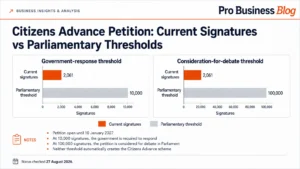
The petition asks the government to adopt the proposal.
When checked on 27 August 2026, it had 2,061 signatures and was scheduled to close on 10 January 2027.
What Happens at 10,000 Signatures?
The government is required to provide a response.
That does not mean Citizens Advance will be introduced.
What Happens at 100,000 Signatures?
The petition can be considered for debate in Parliament.
That still does not automatically create the scheme.
Could the Petition Meet a Threshold Without the Payment Being Introduced?
Yes.
Petition thresholds trigger parts of the Parliamentary petition process. They do not automatically create new legislation or government spending.
What Would Need to Happen Before Applications Could Open?
Several major steps would likely be required.
Would the Government Need to Approve the Policy?
Yes. The government would first need to formally adopt or develop the proposal.
Would Eligibility Rules Need to Be Created?
Yes. Rules would need to define:
- eligible ages;
- qualifying NI years;
- treatment of credits;
- residency requirements;
- treatment of carers;
- other qualifying conditions.
Would a Payment Formula Need to Be Created?
Yes.
Government would need to determine whether the Advance was:
-
a fixed amount;
-
linked to individual entitlement;
-
linked to current State Pension rates.
Would Tax Rules Need to Be Agreed?
Yes.
Would Benefit Rules Need to Be Agreed?
Yes.
Would Funding Need to Be Approved?
Yes.
The Treasury implications could be significant.
Would Pension Legislation Need to Change?
Potentially.
A mechanism would be required to record and apply the future State Pension adjustment.
Would an Official Application System Need to Be Created?
Yes. Only after these stages could genuine applications potentially open.
What Could a Future Application Process Look Like?
The following is an illustration of what a future system might need to include. It is not an existing application process.
Step 1: Verify Identity
The applicant would likely need to prove their identity through an official government service.
Step 2: Check Age
The system would need to confirm that the applicant falls within the permitted age range.
Step 3: Check National Insurance Record
Qualifying years and credits would need to be verified.
Step 4: Confirm Eligibility
The applicant would need to meet all final government conditions.
Step 5: Calculate the Advance
The system would determine the amount available.
Step 6: Explain the Future Pension Consequence
Applicants would need to understand how accepting the Advance affects their later State Pension.
Step 7: Confirm Consent
Participation would require clear acceptance of the future trade-off.
Step 8: Address Tax and Benefit Implications
Relevant consequences would need to be explained.
Step 9: Provide Payment Details
Secure bank details would likely be required.
Step 10: Receive an Official Decision
A formal eligibility and payment decision would then be issued.
None of these application stages currently exists.
How Can You Identify a Potentially Misleading £12,500 Pension Advance Offer?
Because there is no genuine Citizens Advance application process, claims of immediate access should be treated carefully.
Is Someone Asking for an Application Fee?
There is currently no official Citizens Advance application fee.
Is Someone Promising Guaranteed Approval?
No organisation can guarantee eligibility for a scheme that has not been introduced.
Is Someone Asking You to Pay for Priority Access?
There is no official priority list.
Is Someone Asking for Banking Passwords or Security Codes?
Do not provide online banking passwords, PINs or one-time security codes.
Is Someone Asking You to Transfer a Workplace Pension?
That is not part of Citizens Advance.
Citizens Advance concerns future State Pension entitlement, not early release of an existing private or workplace pension.
Does a Social-Media Advert Say Applications Are Open?
Verify the claim through GOV.UK or another official government source before providing any information.
Does a Website Claim There Is an Application Deadline?
There is no current Citizens Advance application deadline.
The Parliament petition has a closing date, but that is not a payment application deadline.
What Can You Do Now If You Are Interested in Citizens Advance?
Although you cannot apply, there are several sensible steps you can take.
Can You Check Your National Insurance Record?
Yes.
This can help you understand the number of qualifying years currently recorded.
Can You Check Your State Pension Forecast?
Yes.
This provides useful context about your projected pension entitlement.
Can You Review Missing Years or Credits?
Yes.
However, do not make voluntary National Insurance contributions purely because you expect Citizens Advance to launch.
Can You Follow Official Updates?
Yes.
Prioritise information from:
-
GOV.UK;
-
UK Parliament;
-
official government announcements.
Should You Pay Someone to Reserve the Payment?
No.
There is no legitimate reservation system.
Should You Make Financial Plans Assuming You Will Receive £12,500?
No.
Until the scheme is approved, the money should not be treated as guaranteed future income.
£12,500 Pension Advance: How to Apply and Who Could Qualify?
Last reviewed: 27 August 2026
If you are searching for 12500 pension advance how to apply, the most important point is that you cannot currently apply for the £12,500 pension advance.
Citizens Advance is a policy proposal rather than an approved UK government scheme. There is no GOV.UK application form, confirmed payment date or official eligibility process.
The proposal has attracted attention because it could potentially allow some younger adults to receive approximately one year’s worth of future State Pension earlier in life. In return, the start of their State Pension payments could be delayed.
The current position can be summarised as follows:
| Key Question | Current Position |
|---|---|
| Can you apply now? | No |
| Is £12,500 currently available? | No |
| Is Citizens Advance a genuine proposal? | Yes |
| Is it government policy? | No |
| Proposed amount | Around £12,500 |
| Proposed NI requirement | Around 10 qualifying years |
| Possible age range discussed | Around 28–40 |
| Official application form | None |
| Confirmed payment date | None |
The Citizens Advance website describes the idea as an early-stage policy proposal associated with Andrew Lewin MP and being developed independently by the Social Market Foundation.
Is the £12,500 Pension Advance Real?
Citizens Advance is real as a policy proposal, but the £12,500 payment is not currently available as a government benefit or pension payment.
This distinction is important because some headlines can make the proposal sound more advanced than it actually is.
What Is Currently Confirmed?
Citizens Advance explores whether qualifying younger adults could receive part of the value of their future State Pension earlier in adulthood.
The proposal has received political, policy and financial-industry attention during 2026.
What Has Been Proposed?
Versions of the proposal have focused on people aged approximately 28 to 40 who have accumulated around 10 qualifying National Insurance years or credits.
An eligible person could potentially receive approximately £12,500 in exchange for their State Pension beginning approximately one year later.
What Is Not Available?
There is currently no:
- GOV.UK application service;
- DWP claim process;
- confirmed payment timetable;
- final eligibility test;
- official tax treatment;
- Universal Credit treatment;
- government launch date;
- application waiting list.
The proposal therefore exists, but the payment does not.
Why Are People Searching for “12500 Pension Advance How to Apply”?
The search has become increasingly relevant because media coverage has focused heavily on the proposed £12,500 figure.
A reader seeing a headline about younger adults accessing £12,500 from their pension could reasonably assume that a new government payment has already launched.
That is not the case.
The current situation involves three separate developments:
- A Citizens Advance policy proposal exists.
- Research has examined how the proposal could work.
- A Parliament petition is asking the government to consider adopting it.
None of those developments creates an application process.
Where Can You Apply for the £12,500 Pension Advance?
There is currently nowhere to apply.
| Possible Route | Application Available? |
|---|---|
| GOV.UK | No |
| DWP | No |
| HMRC | No |
| The Pension Service | No |
| Pension provider | No |
| Bank | No |
| Mortgage lender | No |
| Financial adviser | No |
| Social media | No |
If the government eventually adopts Citizens Advance, an official announcement would need to explain who administers the scheme and how eligible people can apply.
Until that happens, nobody can legitimately submit a Citizens Advance application on your behalf.
Is There a £12,500 Pension Advance Application Form?
No. There is currently no official:
- online application;
- paper claim form;
- downloadable application;
- registration portal;
- eligibility checker.
This makes it especially important to be cautious about websites presenting themselves as application services.
A claim such as:
“Apply for your £12,500 pension advance today”
should be treated carefully unless it can be verified through an official government source.
Can You Register Early or Reserve the £12,500?
No official pre-registration system exists.
There is currently:
| Registration Option | Current Status |
|---|---|
| Early registration | Not available |
| Priority list | Not available |
| Reservation system | Not available |
| Application queue | Not available |
| Paid processing service | Not available |
No company can guarantee that registering with it now will secure access to a future Citizens Advance payment.
Does Signing the Citizens Advance Petition Count as Applying?
No. Signing the petition and applying for a government payment are completely different processes.
| Signing the Petition | Applying for Citizens Advance |
|---|---|
| Shows support for the proposal | Would request a payment |
| Available now | Not currently available |
| Part of the Parliament petition system | Would require a future government system |
| Does not establish eligibility | Would require eligibility checks |
| Does not reserve £12,500 | No reservation process exists |
The petition was published on 10 July 2026 and is scheduled to close on 10 January 2027.
When checked on 27 August 2026, it showed 2,061 signatures.
A petition reaching 10,000 signatures receives a government response, while one reaching 100,000 signatures is considered for debate in Parliament.
Neither threshold automatically introduces Citizens Advance.
Who Could Qualify for the £12,500 Pension Advance?
There is currently no official Citizens Advance eligibility test.
However, policy research gives an indication of how eligibility could work if the proposal were adopted.
Some versions have focused on people:
- aged approximately 28 to 40;
- with around 10 qualifying National Insurance years or credits;
- willing to accept the future State Pension trade-off.
These should be treated as proposed conditions rather than final government rules.
Could a 28-Year-Old Worker Qualify?
Consider someone who began building a qualifying National Insurance record at approximately age 18.
Current age: 28
NI record started: Around age 18
Potential qualifying years: Around 10
This person could potentially fit some versions of the Citizens Advance proposal.
However, age alone would not establish eligibility.
Could a University Graduate Qualify?
Someone who begins building qualifying National Insurance years at around age 21 may reach ten qualifying years at approximately age 31.
NI record started: Around age 21
Potential ten-year point: Around age 31
This illustrates why age 28 should not be treated as an automatic eligibility age.
Could Someone With Caring Responsibilities Qualify?
Potentially.
A National Insurance record does not always depend solely on continuous paid employment.
National Insurance credits can protect a person’s record in certain circumstances, including some caring responsibilities and receipt of qualifying benefits.
A final Citizens Advance scheme would need to specify exactly which credits counted towards eligibility.
Could Someone Under 28 Qualify?
Possibly not under versions of the proposal based on accumulating ten qualifying years from early adulthood.
However, no official minimum age exists because the government has not introduced Citizens Advance.
Why Does Age 28 Keep Appearing in Reports?
The figure is mainly linked to the proposed National Insurance requirement.
A simplified example is:
Age 18
Starts building qualifying National Insurance years
10 qualifying years
Around age 28
Potentially reaches the proposed minimum
This can also be shown as:
| Qualifying Record Starts | Possible 10-Year Point |
|---|---|
| Age 18 | Around 28 |
| Age 19 | Around 29 |
| Age 20 | Around 30 |
| Age 21 | Around 31 |
| Age 23 | Around 33 |
Age 28 should therefore be understood as a possible qualifying-record point rather than a new pension age.
Do You Need to Have Worked for 10 Years?
Not necessarily.
A person’s National Insurance record can contain both contributions and qualifying credits.
Do You Need 10 Years of Continuous Full-Time Employment?
No. That interpretation is too simplistic.
National Insurance qualifying years can sometimes be protected even during periods when somebody is not making ordinary employment contributions.
Could National Insurance Credits Count?
Potentially. Policy discussions have referred to National Insurance credits as well as contributions.
A final government scheme would still need to define exactly what counts.
How Can You Check Whether You Already Have 10 Qualifying Years?
There is no Citizens Advance eligibility checker.
However, you can currently review information that could become relevant if the proposal were adopted.
This includes:
- your National Insurance record;
- qualifying years;
- incomplete years;
- National Insurance credits;
- your State Pension forecast.
Checking these records does not register you for Citizens Advance.
It simply gives you a clearer understanding of your existing pension position.
Where Does the £12,500 Figure Come From?
The figure broadly reflects approximately one year of the full new State Pension.
For the 2026/27 tax year, the full new State Pension is:
£241.30 per week
Multiplied by:
52 weeks
This gives:
£12,547.60 per year
The proposed £12,500 figure is therefore a rounded representation of roughly one year of the full new State Pension at current rates.
Would Everyone Receive Exactly £12,500?
Not necessarily.
Several important questions remain unanswered.
A future government scheme would need to decide:
- whether the payment is fixed;
- whether it depends on individual pension entitlement;
- whether it rises with future State Pension increases;
- whether people with lower projected entitlement receive less;
- when the amount is calculated.
No official Citizens Advance calculation formula currently exists.
What Would You Give Up in Return for £12,500?
Citizens Advance should not be viewed as a grant or additional government benefit.
The central proposal involves receiving money earlier in life in return for State Pension income being delayed later.
| What You Could Receive Earlier | What You Could Give Up Later |
|---|---|
| Around £12,500 while younger | Around one year of State Pension payments |
| House deposit contribution | Delayed pension income |
| Debt reduction | Need alternative income later |
| Career or education funding | Reduced guaranteed income during the delayed period |
| Greater financial flexibility now | Long-term pension uncertainty |
The important question would therefore be whether receiving the money earlier provides sufficient financial benefit to justify the future pension trade-off.
Could £12,500 Help With a First-Home Deposit?
Potentially.
Housing has been one of the most prominent arguments surrounding the proposal.
The table below shows how £12,500 compares with a 5% deposit.
|
Property Price |
5% Deposit | Gap After £12,500 |
|---|---|---|
| £200,000 | £10,000 | £0 |
| £250,000 | £12,500 | £0 |
| £300,000 | £15,000 | £2,500 |
| £350,000 | £17,500 | £5,000 |
| £400,000 | £20,000 | £7,500 |
At a property value of £250,000, £12,500 would equal exactly a 5% deposit.
However, having enough money for a deposit does not guarantee mortgage approval.
Mortgage lenders can still assess:
- income;
- existing borrowing;
- monthly expenditure;
- employment;
- credit history;
- overall affordability.
Could a Couple Receive Around £25,000?
Potentially, but only under a hypothetical future system where both people qualified independently.
The calculation would be:
£12,500 + £12,500 = £25,000
That could provide:
| Property Price | £25,000 as a Percentage |
|---|---|
| £200,000 | 12.5% |
| £250,000 | 10% |
| £300,000 | 8.3% |
| £350,000 | 7.1% |
| £400,000 | 6.25% |
There is currently no confirmed £25,000 entitlement for couples.
Could the Advance Be Used to Repay Debt?
Potentially.
Debt repayment was one of the prominent intended uses identified in research surrounding Citizens Advance.
Reported survey findings indicated:
| Intended Use | Share |
|---|---|
| Debt repayment | 18% |
| Housing | 16% |
For someone carrying expensive credit-card or personal-loan debt, using a lump sum to reduce borrowing could potentially lower future interest costs.
However, no government spending rules exist.
Could the Money Be Used for Education or Retraining?
Potentially.
Citizens Advance has also been discussed in relation to:
- professional qualifications;
- career changes;
- technical training;
- education;
- periods of reduced working hours while retraining.
Again, these are possible uses rather than approved rules.
Could the £12,500 Be Used to Start a Business?
Possibly.
The money could theoretically contribute towards:
- equipment;
- stock;
- training;
- software;
- professional services;
- initial working capital.
There are no confirmed government restrictions on Citizens Advance spending because the scheme has not been introduced.
Does Taking £12,500 Mean You Would Have to Work an Extra Year?
Not necessarily.
There is an important distinction between retirement and State Pension age.
What Does Retirement Mean?
Retirement is the point at which somebody chooses to stop working.
That may depend on:
- workplace pension income;
- private pensions;
- savings;
- investments;
- household income.
What Does State Pension Age Mean?
State Pension age determines when somebody normally becomes eligible to start receiving State Pension.
What Would Citizens Advance Change?
The proposal could delay the start of State Pension payments by approximately one year.
It would not necessarily require somebody to remain employed for an additional year.
A person with sufficient private resources might still choose to stop working earlier.
Would the £12,500 Pension Advance Be Tax-Free?
This has not been confirmed as government policy.
The Parliament petition calls for a tax-free lump sum, but a petition does not establish tax law.
If the government adopted Citizens Advance, formal rules would need to specify:
- whether the payment is taxable;
- whether a special exemption applies;
- whether the full amount is tax-free.
Until official guidance exists, the proposed payment should not automatically be described as tax-free.
Would Citizens Advance Affect Universal Credit?
This is not currently known.
No Citizens Advance Universal Credit rules exist because the scheme has not been introduced.
A future government would need to determine whether the payment is treated as:
- income;
- capital;
- disregarded capital;
- a specially exempt payment.
That distinction could be significant for households receiving means-tested support.
Would Citizens Advance Count as Savings or Capital?
This has not been confirmed.
A future scheme could potentially include special treatment for the payment.
Alternatively, ordinary capital rules could apply.
There is currently no official answer.
Could Citizens Advance Affect Housing Benefit?
No specific Citizens Advance rule currently exists.
Any effect would depend on:
- the final design of the scheme;
- treatment of the payment;
- the recipient’s wider circumstances.
Could It Affect Council Tax Reduction?
Again, this has not been confirmed.
A future government scheme would need to clarify how the payment interacts with means-tested local support.
Could You Repay the Advance Later?
There is no confirmed answer.
A future scheme would need to establish whether taking Citizens Advance is:
- permanent;
- reversible;
- repayable.
No repayment mechanism currently exists.
Why Do Supporters Believe Citizens Advance Could Help Younger Adults?
Supporters argue that many financial pressures occur decades before retirement.
Younger adults may need substantial amounts of money when trying to:
- buy a first home;
- repay expensive debt;
- start a family;
- retrain;
- change career;
- improve their qualifications.
Citizens Advance is designed around the idea of moving a limited portion of pension value from later life to earlier adulthood.
Research reported in 2026 found:
| Research Finding | Result |
|---|---|
| Positive towards Citizens Advance | 54% |
| Negative towards Citizens Advance | 6% |
| Potential take-up | Around 50%–70% |
Potential take-up depended on how the final scheme was designed.
Why Might the Government Be Cautious About Citizens Advance?
The proposal raises several significant policy issues.
Could the Initial Cost Be High?
Yes. Reported modelling suggested that a tightly restricted rollout could cost approximately £1.3 billion in its first year.
A much broader rollout could potentially require substantially more upfront funding.
Why Would the Government Need to Spend Money Earlier?
Under the normal State Pension system, payments begin when somebody reaches the relevant State Pension age.
Citizens Advance would bring some of this spending forward by several decades.
The corresponding State Pension saving would occur much later.
That creates an immediate Treasury funding issue.
Could It Create Retirement-Income Risks?
Yes. Someone accepting the Advance would need to understand how they planned to finance the period before their delayed State Pension began.
Could the Scheme Be Administratively Complex?
Potentially.
An application system might need to check:
- identity;
- age;
- National Insurance history;
- qualifying credits;
- previous Advance claims;
- payment amounts;
- future State Pension adjustments.
How Close Is Citizens Advance to Becoming Available?
The current development stage can be summarised as follows:
| Stage | Status |
|---|---|
| Policy proposal created | Complete |
| Research and modelling | Completed and continuing |
| Public discussion | Underway |
| Parliament petition | Open |
| Government adoption | Not announced |
| Final eligibility rules | Not published |
| Legislation or detailed rules | Not announced |
| GOV.UK application system | Does not exist |
| Payment launch | No date announced |
This explains why people cannot currently apply.
What Does the Citizens Advance Petition Actually Achieve?
The petition asks the government to adopt the proposal.
When checked on 27 August 2026, it had 2,061 signatures and was scheduled to close on 10 January 2027.
What Happens at 10,000 Signatures?
The government is required to provide a response.
That does not mean Citizens Advance will be introduced.
What Happens at 100,000 Signatures?
The petition can be considered for debate in Parliament.
That still does not automatically create the scheme.
Could the Petition Meet a Threshold Without the Payment Being Introduced?
Yes.
Petition thresholds trigger parts of the Parliamentary petition process. They do not automatically create new legislation or government spending.
What Would Need to Happen Before Applications Could Open?
Several major steps would likely be required.
Would the Government Need to Approve the Policy?
Yes. The government would first need to formally adopt or develop the proposal.
Would Eligibility Rules Need to Be Created?
Yes. Rules would need to define:
- eligible ages;
- qualifying NI years;
- treatment of credits;
- residency requirements;
- treatment of carers;
- other qualifying conditions.
Would a Payment Formula Need to Be Created?
Yes.
Government would need to determine whether the Advance was:
- a fixed amount;
- linked to individual entitlement;
- linked to current State Pension rates.
Would Tax Rules Need to Be Agreed?
Yes.
Would Benefit Rules Need to Be Agreed?
Yes.
Would Funding Need to Be Approved?
Yes.
The Treasury implications could be significant.
Would Pension Legislation Need to Change?
Potentially.
A mechanism would be required to record and apply the future State Pension adjustment.
Would an Official Application System Need to Be Created?
Yes.
Only after these stages could genuine applications potentially open.
What Could a Future Application Process Look Like?
The following is an illustration of what a future system might need to include. It is not an existing application process.
Step 1: Verify Identity
The applicant would likely need to prove their identity through an official government service.
Step 2: Check Age
The system would need to confirm that the applicant falls within the permitted age range.
Step 3: Check National Insurance Record
Qualifying years and credits would need to be verified.
Step 4: Confirm Eligibility
The applicant would need to meet all final government conditions.
Step 5: Calculate the Advance
The system would determine the amount available.
Step 6: Explain the Future Pension Consequence
Applicants would need to understand how accepting the Advance affects their later State Pension.
Step 7: Confirm Consent
Participation would require clear acceptance of the future trade-off.
Step 8: Address Tax and Benefit Implications
Relevant consequences would need to be explained.
Step 9: Provide Payment Details
Secure bank details would likely be required.
Step 10: Receive an Official Decision
A formal eligibility and payment decision would then be issued.
None of these application stages currently exists.
How Can You Identify a Potentially Misleading £12,500 Pension Advance Offer?
Because there is no genuine Citizens Advance application process, claims of immediate access should be treated carefully.
Is Someone Asking for an Application Fee?
There is currently no official Citizens Advance application fee.
Is Someone Promising Guaranteed Approval?
No organisation can guarantee eligibility for a scheme that has not been introduced.
Is Someone Asking You to Pay for Priority Access?
There is no official priority list.
Is Someone Asking for Banking Passwords or Security Codes?
Do not provide online banking passwords, PINs or one-time security codes.
Is Someone Asking You to Transfer a Workplace Pension?
That is not part of Citizens Advance. Citizens Advance concerns future State Pension entitlement, not early release of an existing private or workplace pension.
Does a Social-Media Advert Say Applications Are Open?
Verify the claim through GOV.UK or another official government source before providing any information.
Does a Website Claim There Is an Application Deadline
There is no current Citizens Advance application deadline.
The Parliament petition has a closing date, but that is not a payment application deadline.
What Can You Do Now If You Are Interested in Citizens Advance?
Although you cannot apply, there are several sensible steps you can take.
Can You Check Your National Insurance Record?
Yes.
This can help you understand the number of qualifying years currently recorded.
Can You Check Your State Pension Forecast?
Yes.
This provides useful context about your projected pension entitlement.
Can You Review Missing Years or Credits?
Yes.
However, do not make voluntary National Insurance contributions purely because you expect Citizens Advance to launch.
Can You Follow Official Updates?
Yes.
Prioritise information from:
- GOV.UK;
- UK Parliament;
- official government announcements.
Should You Pay Someone to Reserve the Payment?
No.
There is no legitimate reservation system.
Should You Make Financial Plans Assuming You Will Receive £12,500?
No.
Until the scheme is approved, the money should not be treated as guaranteed future income.
Can I Apply for the £12,500 Pension Advance Now?
No. There is currently no official application system.
Is the £12,500 Pension Advance Real?
Citizens Advance is a real policy proposal, but the payment is not currently available.
Is Citizens Advance Government Policy?
No. It remains a proposal rather than an approved government scheme.
Who Could Qualify?
Some versions focus on adults around 28–40 with approximately ten qualifying National Insurance years or credits.
Is There a GOV.UK Application?
No.
When Will Applications Open?
No launch date has been announced.
Is £12,500 Guaranteed?
No. It is a headline figure based broadly on approximately one year of the full new State Pension.
Could It Be Used as a House Deposit?
Potentially, but no official spending rules exist.
Would Couples Receive £25,000?
Only hypothetically if both partners independently qualified under a future scheme.
Would the Payment Be Tax-Free?
This has not been confirmed.
Would It Affect Universal Credit?
This has not been confirmed.
Do National Insurance Credits Count?
They have featured in policy discussions, but final government eligibility rules do not exist.
Does Signing the Petition Count as Applying?
No.
Would You Have to Work an Extra Year?
Not necessarily. The proposal concerns delaying State Pension payments rather than legally requiring somebody to remain employed.
What Is the Current Position on the £12,500 Pension Advance?
For anyone searching 12500 pension advance how to apply, the position as of 27 August 2026 is straightforward.
| Question | Answer |
|---|---|
| Can you apply? | No |
| Is Citizens Advance a genuine proposal? | Yes |
| Is it government policy? | No |
| Is £12,500 guaranteed? | No |
| Have around 10 NI years been proposed? | Yes |
| Have ages around 28–40 been discussed? | Yes |
| Is there a confirmed launch date? | No |
| Should you pay to reserve the payment? | No |
Citizens Advance could become an important policy debate about whether younger adults should be able to access some future State Pension value earlier in life.
For now, however, it remains a proposal rather than an application-based government scheme.
Readers interested in the idea should review their existing National Insurance record, check their State Pension forecast, follow official government developments and avoid treating unofficial £12,500 application offers as confirmed government services.
FAQs
Can I Apply for the £12,500 Pension Advance Now?
No. There is currently no official application system.
Is the £12,500 Pension Advance Real?
Citizens Advance is a real policy proposal, but the payment is not currently available.
Is Citizens Advance Government Policy?
No. It remains a proposal rather than an approved government scheme.
Who Could Qualify?
Some versions focus on adults around 28–40 with approximately ten qualifying National Insurance years or credits.
When Will Applications Open?
No launch date has been announced.
Is £12,500 Guaranteed?
No. It is a headline figure based broadly on approximately one year of the full new State Pension.
Could It Be Used as a House Deposit?
Potentially, but no official spending rules exist.
Would Couples Receive £25,000?
Only hypothetically if both partners independently qualified under a future scheme.
Would the Payment Be Tax-Free?
This has not been confirmed.
Would It Affect Universal Credit?
This has not been confirmed.
Do National Insurance Credits Count?
They have featured in policy discussions, but final government eligibility rules do not exist.
Would You Have to Work an Extra Year?
Not necessarily. The proposal concerns delaying State Pension payments rather than legally requiring somebody to remain employed.