


BGC on a bank statement stands for Bank Giro Credit. It normally indicates that money has been credited to the account, often through a cash or cheque deposit, an over-the-counter payment or another transaction processed using bank giro arrangements.
However, that is only half of what Bank Giro Credit means.
A Bank Giro Credit can also be a physical payment slip, traditionally printed at the bottom of a bill or invoice. The payer completes or presents the slip with cash or a cheque so that money can be credited to the organisation named on it.
That distinction matters because someone searching for “BGC” may have found the abbreviation on a bank statement, while someone else may be holding a Bank Giro Credit slip attached to a council tax, utility or credit-card bill.
What Does BGC Actually Mean?
BGC is the banking abbreviation for Bank Giro Credit.
A Bank Giro Credit is fundamentally a method of crediting money to a bank account. Traditionally, it involves written payment instructions, often on a pre-printed form supplied by the organisation receiving the money.
The word giro comes from European banking terminology associated with the circulation or transfer of money between accounts. Giro systems have long been used across Europe, so the concept is not uniquely British.
Although electronic payments such as Faster Payments and Direct Debits have replaced many traditional paper transactions, Bank Giro Credit terminology remains visible on UK bank statements and payment documents.
Is BGC a Debit or a Credit?
BGC is normally a credit.
If BGC appears next to money received in a bank account, it means the account has been credited rather than debited.
| Statement Entry | Money In/Out | Meaning |
| BGC £500 | Money in | Bank Giro Credit received |
| DD £75 | Money out | Direct Debit collected |
| FPI £250 | Money in | Faster Payment received |
| FPO £100 | Money out | Faster Payment sent |
| CHG £10 | Money out | Bank charge |
The exact layout varies between banks, but BGC itself stands for Bank Giro Credit.
Why Does BGC Appear on a Bank Statement?
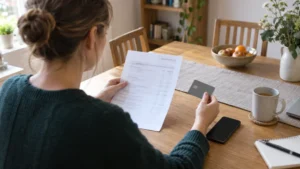
Banks use abbreviated transaction codes to fit payment information into statements, downloadable PDFs and online banking systems.
A BGC entry may appear after:
- Cash has been paid into an account over a branch counter.
- A cheque has been deposited.
- Someone has paid money using a Bank Giro Credit slip.
- A business or organisation has processed a payment through a giro arrangement.
- A bank has classified an incoming credit using its BGC transaction code.
It should not automatically be assumed that every salary, refund, pension or benefit payment will appear as BGC.
Banks have multiple codes for incoming payments. A salary may instead appear as BACS, BAC, FPI or under the employer’s name, while a government payment may contain DWP, HMRC or another identifying reference.
This is why the transaction description and reference are just as important as the BGC code itself.
What Is a Physical Bank Giro Credit Form?
A Bank Giro Credit form is a paper payment instruction.
Traditionally, businesses, councils, lenders, utility providers and other organisations included one at the bottom of a bill or invoice.
Rather than manually writing out all of the recipient’s bank details, the payment slip usually already contains the information needed to direct the money to the correct account.
A typical BGC slip may contain:
- The recipient’s name.
- Bank sort code.
- Account number.
- Customer or invoice reference.
- Amount to be paid.
- Space for a payer reference.
- Cash and cheque fields.
- Date information.
- Cashier stamp area.
- Sometimes a barcode or other payment-processing information.
The exact design varies between organisations and banks.
The important feature is that the recipient’s payment details are normally pre-printed, reducing the risk of the payer sending the money to the wrong account.
How Does Someone Pay a Bill Using a BGC Slip?
Where Bank Giro Credit is still accepted, the process is generally straightforward.
1. Check the BGC Slip
The payer should confirm that the slip belongs to the bill being paid and that the account or customer reference is correct.
Pre-printed banking information should not be changed unless the organisation that issued the bill specifically instructs the customer to do so.
2. Complete Any Required Fields
Depending on the slip, the payer may need to enter:
- The amount.
- Payment date.
- Name.
- Customer reference.
- Details of the accompanying cheque.
Some information may already be printed.
3. Prepare the Payment
The organisation may allow payment using:
- Cash.
- Cheque.
- Another payment method specified on the bill.
The payer should follow the instructions printed on the actual bill because acceptance arrangements vary.
4. Take It to an Accepted Payment Location
Traditionally, Bank Giro Credit slips are presented at a bank branch.
Some bills can also be paid through a Post Office, although Post Office acceptance depends on the arrangement the organisation has in place.
A council or utility provider may, for example, provide a barcode-enabled bill for Post Office payment rather than allowing every generic Bank Giro Credit form to be accepted.
The fact that a document says “Bank Giro Credit” therefore does not guarantee that every Post Office or bank will process it.
5. Keep Evidence of Payment
A stamped counterfoil, receipt or other payment confirmation should be retained until the payment appears on the relevant account.
This can be particularly useful when paying close to a bill’s deadline.
Can a Bank Giro Credit Be Submitted Online?
A traditional paper Bank Giro Credit slip is not normally something a customer simply uploads through online banking.
However, modern billers frequently provide online alternatives.
For example, if the bill contains the recipient’s bank details and reference number, the customer may be able to make an online bank transfer instead.
Some organisations also provide:
- Online card payments.
- Faster Payment instructions.
- Direct Debit.
- Telephone payments.
- Customer payment portals.
These may achieve the same practical objective — paying the bill — without actually processing the paper BGC form.
The payment method should not be described as Bank Giro Credit simply because the same recipient and reference are being used. An online Faster Payment remains a Faster Payment.
What Is the Difference Between a BGC Slip and a Paying-In Slip?
Bank Giro Credit forms and paying-in slips can look similar, but they serve different purposes.
| Feature | Bank Giro Credit | Paying-In Slip |
| Main purpose | Pay money to another account or organisation | Deposit money into the account holder’s own account |
| Recipient details | Usually pre-printed by the biller | Usually linked to the account holder |
| Common location | Attached to a bill or invoice | Paying-in book or bank deposit stationery |
| Typical use | Council tax, bills, invoices and account payments | Cash and cheque deposits |
| Reference | Often includes customer or invoice reference | Usually identifies the depositor’s account |
A paying-in slip is therefore primarily used to deposit money into the person’s own bank account.
A Bank Giro Credit slip directs money towards the recipient identified on the form.
The distinction is particularly important when dealing with business invoices and payment reconciliation.
How Long Does a BGC Payment Take?
A Bank Giro Credit should not be treated as an instant payment.
Around three working days is often used as a practical estimate for traditional giro processing, but it is not a guaranteed timeframe for every BGC transaction.
Actual processing can depend on:
- The bank receiving the payment.
- Where the payment was made.
- Whether cash or cheque was used.
- Cheque-clearing requirements.
- The organisation receiving the money.
- Weekends and bank holidays.
- How quickly the biller’s accounting system applies the payment.
Some organisations tell customers to allow considerably longer than three working days for a Bank Giro Credit payment to reach and be allocated to their account.
Anyone paying an important bill should therefore follow the recipient’s stated processing time rather than assuming three days will always be sufficient.
Where a cheque is involved, the cheque’s own clearing process can also affect when the money becomes available.
Are Bank Giro Credit Payments Free?
Bank Giro Credit payments can be free, but they are not universally fee-free.
A payer may be able to use the service without a charge when:
- Paying through their own bank.
- Paying into an account held with the receiving bank.
- The recipient has an arrangement covering the processing cost.
However, a bank may charge if a non-customer uses its counter service or if money is being paid to an account held elsewhere.
Post Office charges can also depend on the arrangement established by the organisation receiving the payment.
The safest approach is to check before paying rather than assuming every BGC transaction is free.
What Are the Advantages of Bank Giro Credit?
Although it is an older payment method, Bank Giro Credit still offers several practical advantages.
Clear Recipient Information
Pre-printed recipient details reduce the need for the payer to type sort codes and account numbers manually.
Useful for Customers Who Do Not Bank Online
A customer can potentially make a payment without using mobile or internet banking.
Cash and Cheque Support
Where accepted, Bank Giro Credit can provide a practical way to pay a bill using cash or cheque.
References Help Allocate Payments
Customer numbers and invoice references make it easier for organisations to identify which account should receive the payment.
Potentially No Fee
Some BGC arrangements allow payment without a processing charge.
What Are the Disadvantages?
There are also significant drawbacks.
Slower Than Faster Payments
Traditional paper processing cannot normally compete with electronic payments that often reach the recipient within seconds or minutes.
Requires Manual Handling
The payer may need to visit a branch or other payment location.
Not Accepted Everywhere
Bank branches have changed substantially as banking has moved online, and organisations increasingly prefer electronic payments.
Fees Can Apply
A payment is not automatically free merely because a Bank Giro Credit slip is provided.
Poor Choice for Recurring Bills
Direct Debit or Standing Order is normally more convenient for payments that repeat every month.
Reconciliation Can Be Difficult
Missing or incorrect references can make it difficult for a business to match the money against the correct invoice.
Do Halifax, Lloyds, NatWest and Barclays Use BGC Differently?
Bank statement terminology varies, so customers should not assume every bank will display the same payment in exactly the same way.
Several major UK banks explicitly recognise BGC as Bank Giro Credit.
For example:
- Halifax includes BGC within its statement payment codes.
- Lloyds uses BGC within its statement transaction types.
- NatWest identifies BGC as Bank Giro Credit and associates the code with branch deposits of cash or cheques using paying-in facilities.
- Barclays also recognises BGC as a bank-statement abbreviation.
However, those banks also use numerous other transaction codes.
An incoming transfer might therefore display as BGC, FPI, BAC, CRE, a payer’s name or another description depending on the payment method and account system.
This is why statements from different banks should not be compared solely by abbreviation.
Even apparently similar transactions can be labelled differently.
The same problem occurs with merchant descriptions. For example, a customer trying to understand SumUp on a bank statement may see the payment processor rather than the business name they remember.
What Other Bank Statement Abbreviations Should Customers Know?
BGC is only one of dozens of abbreviations used by UK banks.
| Code | Meaning | Typical Purpose |
| BGC | Bank Giro Credit | Giro, branch or deposit credit |
| BAC/BACS | Bankers’ Automated Clearing Services | Automated account credit/payment |
| BP | Bill Payment | Payment of a bill |
| CHG | Charge | Bank fee or charge |
| CHQ | Cheque | Cheque transaction |
| DD/D/D | Direct Debit | Organisation collects money automatically |
| DWP | Department for Work and Pensions | Benefit-related payment reference at some banks |
| FPI | Faster Payment In | Faster Payment received |
| FPO | Faster Payment Out | Faster Payment sent |
| SO/S/O | Standing Order | Scheduled account-to-account payment |
| TFR | Transfer | Transfer between accounts |
| CRE | Credit | Money credited to an account |
| CPT/ATM | Cashpoint | Cash-machine transaction |
| DEP | Deposit | Money paid into an account |
| COR | Correction | Banking adjustment or correction |
| REV | Reversal | Previous transaction reversed |
Not every bank uses every abbreviation.
For example, one bank may display “FPI” while another banking app simply shows the sender’s name and “Faster Payment”.
Can Someone Make a BGC Payment to Another Person?
Potentially, yes.
A Bank Giro Credit is fundamentally a way of paying money into another bank account.
However, the traditional consumer use generally involves a BGC form supplied by the person or organisation receiving the payment.
Someone does not normally need a Bank Giro Credit form simply to send money to a friend.
Today, a Faster Payment is usually considerably simpler. The payer normally enters the recipient’s:
- Name.
- Sort code.
- Account number.
- Payment reference.
BGC remains more relevant where a biller has deliberately supplied a giro slip or where an over-the-counter deposit is being processed.
Can a Bank Giro Credit Be Recalled or Reversed?
A Bank Giro Credit does not normally provide the same chargeback-style protection associated with card payments.
Once a correctly authorised giro-style payment has been processed, the payer should not assume that it can simply be recalled.
The position can differ depending on how the payment was funded.
For example, a transaction may be reversed or adjusted if:
- An accompanying cheque is returned unpaid.
- The bank identifies a processing error.
- An incorrect credit is corrected.
- The recipient agrees to return the money.
- The banks involved recover a payment sent in error.
This is different from having a guaranteed right to recall a completed payment.
Anyone who believes a BGC payment has been made incorrectly should contact the bank as soon as possible.
What If an Unexpected BGC Payment Appears?

An unexpected credit should not automatically be treated as free money.
The account holder should first check:
- The Amount — Does it match a refund, repayment or deposit?
- The Date — Was money recently paid in?
- The Reference — Does it identify an individual, organisation, invoice or account?
- Recent Cheques or Cash Deposits — Was anything paid in at a branch?
- Business Records — Could it relate to a customer invoice?
- Joint-Account Activity — Could another authorised account holder explain it?
If the payment remains unexplained, the bank should be asked for any additional transaction information it can provide.
The money should not be spent simply because it has cleared.
Banks can correct mistaken payments in some circumstances.
This principle applies more broadly to unfamiliar statement entries.
A transaction carrying a recognisable organisation’s name can still require investigation, just as Creation.co.uk on a bank statement may need to be matched against an underlying finance agreement before the account holder knows exactly what it represents.
Why BGC Payments Can Cause Problems for Business Bookkeeping?
BGC entries can be particularly frustrating for small businesses, finance teams and bookkeepers.
A bank statement may show that £1,250 has arrived, but the BGC description alone may not identify:
- Which customer paid.
- Which invoice was settled.
- Whether several invoices were combined.
- Whether the payment was a refund.
- Whether the payer entered the correct reference.
- Whether the money belongs to another customer account.
This can create an unallocated cash problem.
The bank balance is correct, but the accounting ledger cannot be updated confidently because the finance team does not know what the payment relates to.
How Businesses Should Reconcile Unclear BGC Deposits?
A practical reconciliation process is:
- Record the BGC date and exact value.
- Check the complete bank reference rather than only the abbreviation.
- Search outstanding invoices for the same amount.
- Review remittance emails and customer correspondence.
- Check whether several invoices total the deposited amount.
- Ask the likely customer to confirm the payment reference.
- Keep the payment in an unidentified or suspense category until it can be allocated properly.
Businesses should avoid matching a payment to an invoice merely because the amounts happen to be similar.
Good payment-reference practices can reduce these problems considerably.
Invoices should clearly tell customers which reference to quote, ideally using a unique invoice or customer number.
BGC vs BACS vs Faster Payments vs Direct Debit
The terms are sometimes confused because all involve moving money through banks.
| Payment Method | Who Starts It? | Typical Speed | Common Use |
| Bank Giro Credit | Payer | Several working days can be required | Paper bills, cash/cheque payments, branch credits |
| BACS credit | Payer/business | Usually multiple working days | Payroll and bulk business payments |
| Faster Payment | Payer | Usually seconds or minutes | Everyday bank transfers |
| Direct Debit | Organisation being paid | Collected on scheduled date | Recurring bills |
| Standing Order | Account holder | According to scheduled payment | Rent, savings and fixed recurring payments |
The distinction is particularly important when investigating an unfamiliar transaction.
BGC describes a credit method or transaction classification, not the name of a company taking or sending the money.
Is Bank Giro Credit Still Used in the UK?
Yes, although it is considerably less prominent than it once was.
Mobile banking, Faster Payments, Direct Debits and online card payments have removed much of the need for paper giro slips.
Nevertheless, BGC remains relevant because:
- Major banks still recognise the abbreviation.
- Some businesses and public bodies continue to provide giro payment facilities.
- Cash and cheque deposits still exist.
- Historic accounts and payment processes continue to use the terminology.
- Customers still encounter BGC on bank statements.
It is therefore an older banking term rather than an obsolete one.
FAQs
What Does BGC Mean on a Bank Statement?
BGC means Bank Giro Credit. It normally indicates that money has been credited to the account, commonly through a giro, cash deposit, cheque deposit or related banking process.
Is BGC a Debit or Credit?
BGC is normally a credit, meaning money has entered the account rather than been taken out.
What Is a Bank Giro Credit Slip?
It is a paper payment form, often attached to a bill or invoice, containing the recipient’s banking and reference information. It can be used to direct a cash or cheque payment to the correct account.
Can a Bank Giro Credit Be Paid at the Post Office?
Some can, but not every BGC slip is automatically accepted. The organisation receiving the payment must support the relevant Post Office payment arrangement. The instructions printed on the bill should be checked first.
Can a BGC Payment Be Made Online?
A traditional paper BGC form is not generally uploaded through ordinary online banking. However, the biller may provide account details allowing the customer to make an electronic bank transfer instead.
How Long Does Bank Giro Credit Take?
Around three working days is often quoted as a useful estimate for traditional processing, but it is not guaranteed. Some organisations require customers to allow longer, particularly where manual processing or cheque clearing is involved.
Are Bank Giro Credit Payments Free?
They can be free, especially under certain bank or biller arrangements, but fees may apply in other circumstances. Customers should check with the bank or payment location before proceeding.